Imagine being able to look at thousands of numbers, customer records, sales reports, or website data and turn them into a clear business decision. That is the real power of Data Analytics. Today, companies are producing more data than ever, but data becomes valuable only when skilled professionals can understand it, identify patterns, and convert it into useful insights.
For students planning a technology career, Data Analytics is becoming an increasingly relevant field because businesses across finance, healthcare, retail, education, e-commerce, marketing, manufacturing, and technology depend on data-driven decisions. At the same time, Data Science is expanding into areas such as artificial intelligence, machine learning, automation, and predictive modelling.
The World Economic Forum’s Future of Jobs Report 2025 identifies AI and big data among the fastest-growing skill areas for 2025–2030. It also lists roles such as Big Data Specialists, AI and Machine Learning Specialists, and Business Intelligence Analysts among growing technology-related careers.
Table of Contents
Trend 1: AI-Powered Data Analytics
One of the biggest changes in Data Analytics Course is the growing use of artificial intelligence. AI tools can assist professionals with repetitive analysis, pattern identification, forecasting, data preparation, and report generation.
However, AI does not remove the need for analytical skills. Instead, it changes how professionals work with data. Students need to understand what questions to ask, how to verify AI-generated results, and how to interpret information correctly.
The growing connection between Data Analytics and AI makes it important for students to learn both traditional analytical concepts and modern AI-assisted workflows. The WEF reports that AI and big data are expected to be among the fastest-growing skills through 2030.
Trend 2: Data Visualization and Business Intelligence
Numbers are difficult to understand when they are presented as endless rows and columns. Data visualisation solves this problem by converting information into charts, dashboards, graphs, and interactive reports.
Modern Data Analytics professionals are increasingly expected to communicate insights clearly. A student may discover an important trend, but that insight has little value if a manager or client cannot understand it.
This is why a practical Data Analytics Course should include dashboard creation and visual storytelling. Students can learn to present complicated information in a simple format that helps organisations make faster decisions.
Business Intelligence is also closely connected with Data Science because both fields help organisations use information more effectively, although their roles and methods can differ.
Trend 3: Predictive Analytics and Forecasting
Traditional Data Analytics often focuses on understanding what has already happened. Predictive analytics goes one step further by using historical information and statistical or machine-learning techniques to estimate what may happen next.
Businesses can use predictive models to understand possible customer behaviour, sales patterns, demand, financial risks, and operational changes.
This is where Data Science becomes particularly valuable. Students who understand statistics, programming, data preparation, and machine learning can progress from simply analysing historical information toward building predictive solutions.
A Data Science Course can introduce learners to these concepts and help them understand how predictive models are created, evaluated, and used responsibly.
Trend 4: Data Science and Machine Learning Working Together
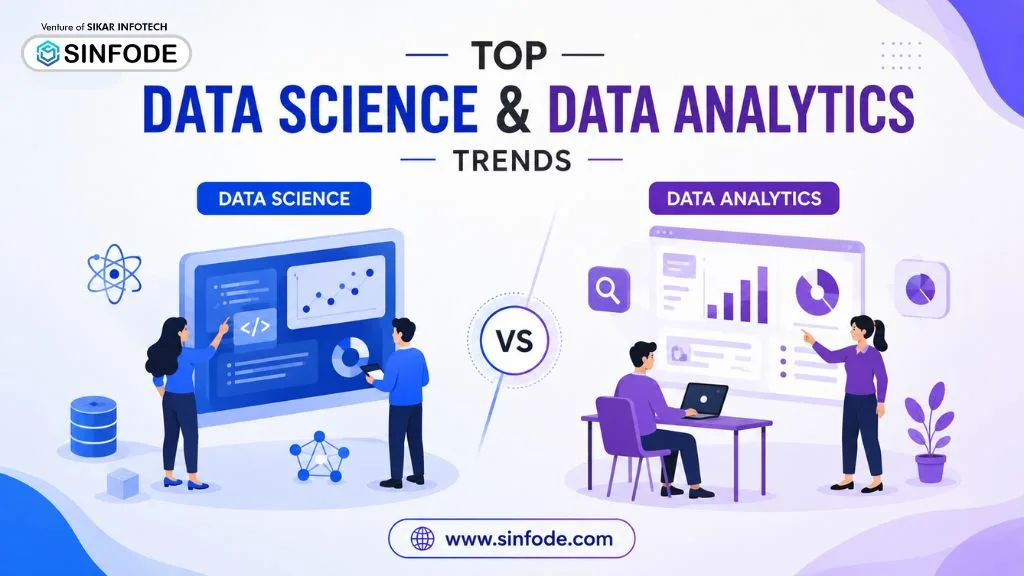
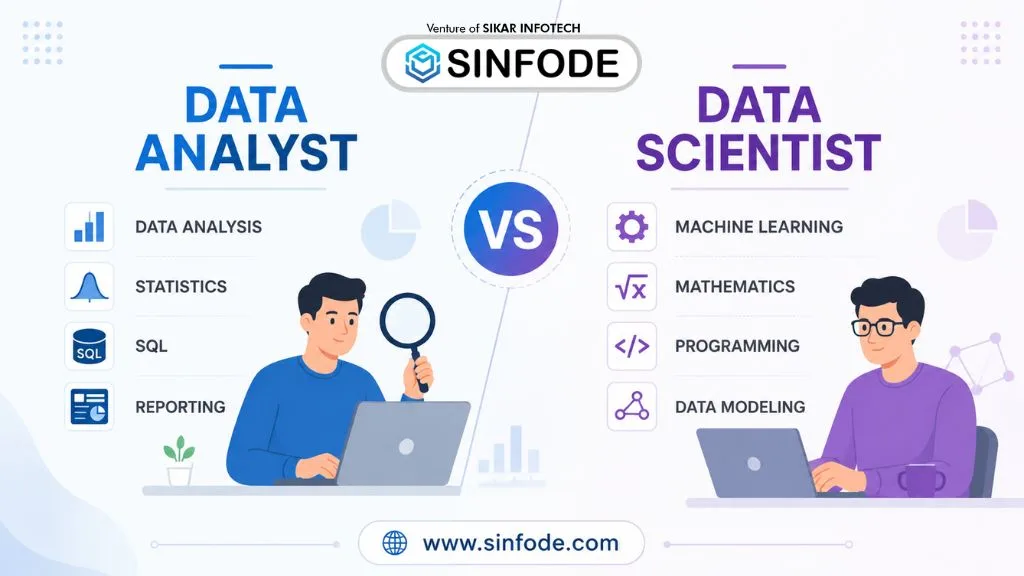
The relationship between Data Analytics and Data Science is becoming increasingly important. Analytics can help explain patterns and support business decisions, while data science can use programming, statistics, and machine learning to solve more complex problems.
For students, understanding this relationship creates more flexibility. Someone who begins with Data Analytics can gradually move toward advanced areas of Data Science after developing the required mathematical, programming, and analytical foundation.
Machine learning is particularly important because it enables systems to learn patterns from data and make predictions or classifications. This technology is being applied across industries, which is increasing demand for professionals with relevant technical skills.
Trend 5: Real-Time Data and Faster Decisions
Businesses increasingly want information while events are happening rather than waiting for monthly or quarterly reports. Real-time Data Analytics in Sikar allows organisations to monitor changing conditions and respond more quickly.
For example, an online business can monitor customer activity, a logistics company can track operations, and a financial organisation can observe transactions as they occur.
This trend is increasing the importance of tools and systems that can process large volumes of information efficiently. Students interested in Data Analytics should therefore understand that modern analytics is moving toward faster, more connected, and continuously updated information environments.
Trend 6: Cloud-Based Data Analytics
Cloud technology has changed how organisations store and process information. Instead of relying only on local infrastructure, businesses can use cloud platforms to manage large datasets and provide access to analytical tools across teams.
For students, this means modern Data Analytics education should include an awareness of cloud-based workflows and data environments.
Understanding how data moves from collection and storage to analysis and reporting can give learners a broader view of the complete data ecosystem. This knowledge can also complement skills learned through other IT Courses in India.
Trend 7: Data Privacy and Responsible Use
More data means greater responsibility. Companies collect personal, financial, behavioural, and operational information, making privacy and security important parts of modern Data Analytics.
Students entering the field should understand that accurate analysis is not enough. Data must also be handled responsibly. Professionals need to consider privacy, security, bias, transparency, and ethical use when working with information.
As AI and Data Science become more integrated into business processes, responsible data practices will become increasingly important. Students who combine technical knowledge with ethical thinking can be better prepared for professional environments.
Trend 8: The Growing Importance of Practical Skills
One of the most important trends for students is the shift toward practical, job-oriented learning. Employers increasingly value candidates who can demonstrate what they can actually do rather than simply list technologies on a resume.
A strong Data Analysis Course should give students opportunities to work with realistic datasets, create dashboards, analyse business problems, and explain their findings.
Projects can also help students build portfolios. A portfolio showing sales analysis, customer segmentation, business dashboards, or forecasting projects can provide employers with a clearer understanding of a learner’s capabilities.
The WEF also highlights analytical thinking, creative thinking, technological literacy, and lifelong learning as important skills alongside AI and big data.
Build Data Skills with Sinfode Academy
Choosing the right learning environment matters when starting a technology career. Sinfode Academy focuses on career-oriented education designed to help students develop practical digital and technical skills.
For learners interested in Data Analysis, structured training can help them understand analytical concepts progressively instead of trying to learn multiple tools without a clear direction. Students can work toward understanding data handling, visualisation, reporting, analytical thinking, and other relevant concepts.
Those who want to move further into Data Science can gradually build additional knowledge in programming, statistics, machine learning, and advanced analytical methods.
Sinfode Academy also provides a range of IT Courses in India, allowing students to explore different technology-oriented career paths according to their interests and professional goals.
📞 Call Us: +91 8619306970
🌐 Contact Us: Sinfode Academy Contact Us
FAQs
1. What is the difference between data analysis and data science?
Data analysis focuses mainly on finding insights from existing information, while data science also involves programming, statistics, machine learning, and predictive modelling.
2. Is data analytics a good career option for students?
Yes. It is a growing career field used across finance, healthcare, e-commerce, marketing, education, technology, and many other industries.
3. What skills are required to become a data analyst?
Important skills include Excel, SQL, statistics, data visualization, problem-solving, and basic programming. Good communication skills are also valuable.
4. Is coding necessary for a career in data?
Basic coding can be very helpful, especially when working with large datasets and automation. Python and SQL are commonly useful technologies for beginners.
5. Which programming language is best for data-related careers?
Python is one of the most popular choices because it is beginner-friendly and has extensive libraries for analysis, visualization, machine learning, and automation.